
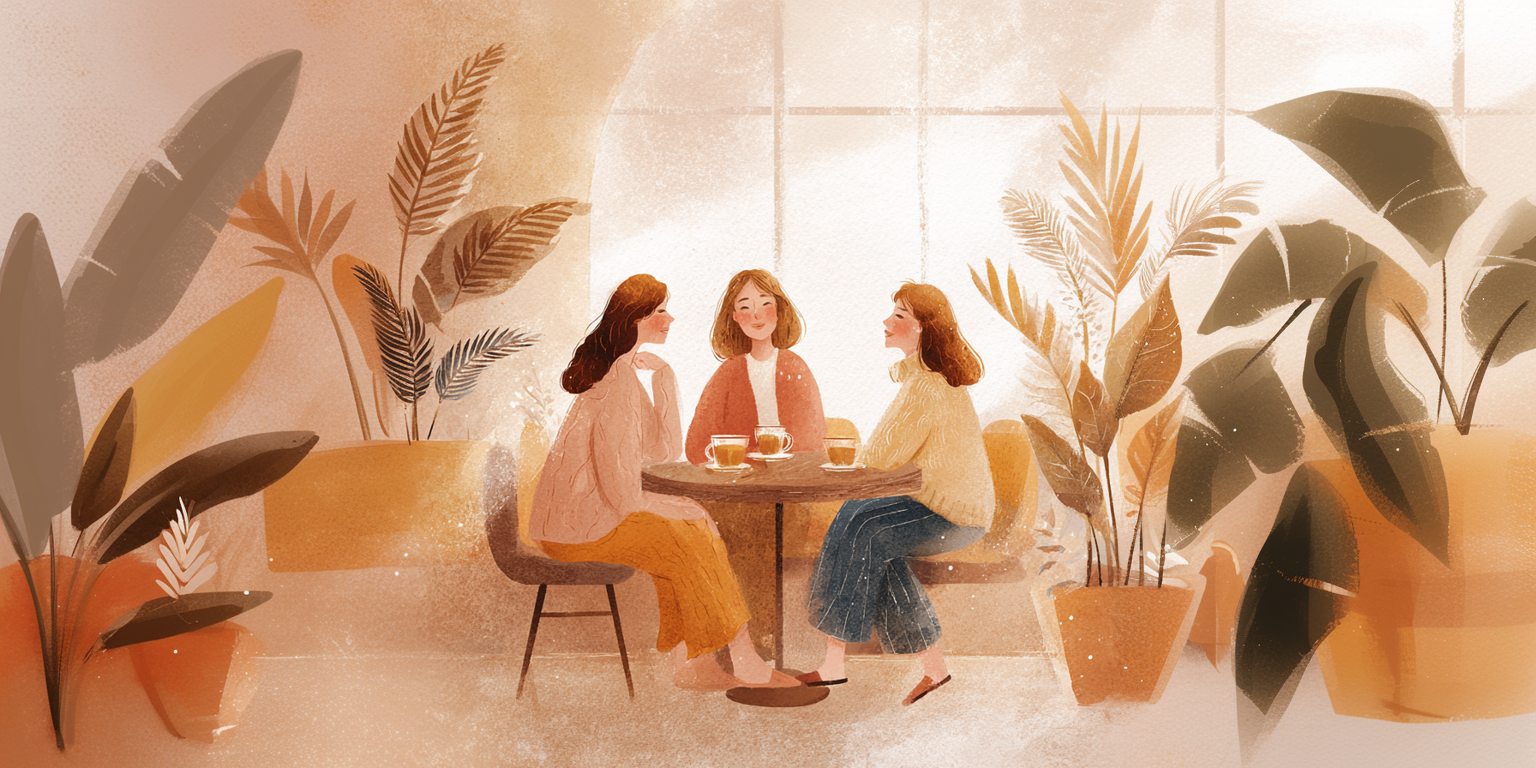
Reconstructing women’s sense of agency and value during the transitional phase.
Although most women will go through menopause in midlife, the knowledge surrounding it is still scattered, uneven, and often hard to truly understand. The World Health Organization points out that, around the world, information about menopause is still mainly delivered through a biomedical, symptom-centered lens, with little attention to emotional life, social roles, or everyday experience (WHO, 2023). Clinical research echoes this, noting that standard care tends to focus on identifying symptoms and prescribing treatments, often treating menopause as a list of risks rather than a whole-life transition that touches body, mind, and identity (Delamater & Santoro, 2023).
This lack of integrated understanding does not stay at the level of information—it quietly affects how women feel. Data from the long-term SWAN study show that women who describe menopause-related information as insufficient or confusing report significantly higher levels of anxiety and depression, regardless of their actual hormonal status (EL Khoudary et al., 2019). On a global scale, about 20–35% of women experience clinically meaningful depressive symptoms during the menopausal transition, and uncertainty—having no clear way to make sense of what is happening—has been identified as a major contributing factor (Bromberger & Epperson, 2018). In China, analysis of the national CHARLS dataset further shows that social support and subjective well-being play a crucial role in buffering depression during menopause, revealing how costly it can be, emotionally, when understanding and support are missing (Xie et al., 2024).
Beyond the lack of information, there is also something quieter and deeper: a kind of “experiential aphasia.” Many women simply do not have the words, the spaces, or the permission to talk about what they are going through. Feminist health studies have long observed that when menopause is framed mainly as decline or loss, women are subtly encouraged to remain silent and to endure rather than speak (Loppie & Keddy, 2002). Surveys in China similarly show that many midlife women see emotional distress during menopause as a purely “personal matter,” not something to be shared or socially acknowledged, which reflects how deeply stigma has been internalized (Zhao, 2010).
Digital platforms have begun to open new spaces for expression, and more women are telling their stories online. Yet research suggests that these voices are still scattered. A national study of Chinese lifestyle and social media platforms found that although menopause-related experiences are increasingly shared, the content is often fragmented, short-lived, and weakly connected to reliable knowledge systems, making it hard for individual stories to accumulate into lasting, shared understanding (Lin & Miao, 2024).
What all this seems to say is that women do not only need more information; they need places where their experiences can be spoken, heard, and gently woven together. Only when personal stories are treated as meaningful knowledge, and when emotions are allowed to be part of the conversation, can menopause be understood not as a lonely medical episode, but as a shared human transition.
Information source
https://www.who.int/news-room/fact-sheets/detail/menopause
https://journals.lww.com/clinicalobgyn/Fulltext/2023/12000/Management_of_the_Perimenopause.10.aspx
https://womensmidlifehealthjournal.biomedcentral.com/articles/10.1186/s40695-019-0049-3
发表回复